PMNS Matrix
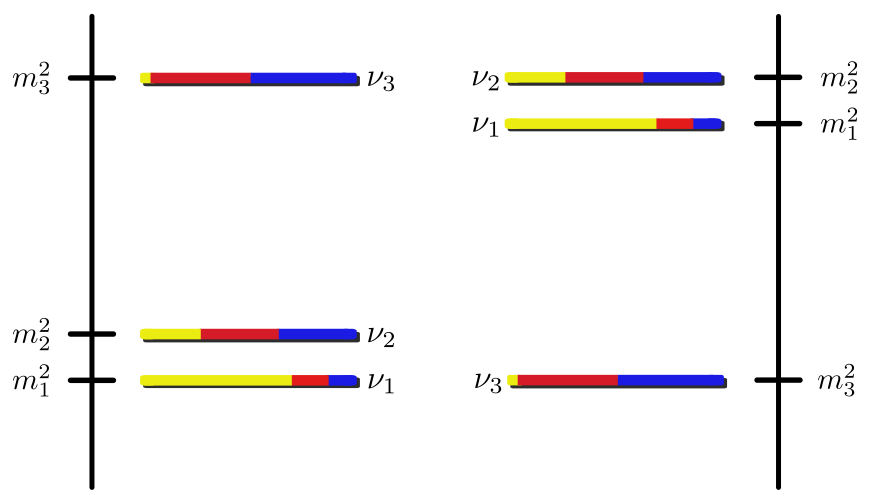

The PMNS matrix is the mathematical form of neutrino oscillation. It describes how the three kinds of neutrino that one creates and measures are related to the three states that have a definite mass.
Its name stands for Pontecorvo, Maki, Nakagawa and Sakata.
Two ways of describing a neutrino
The heart of the matter is a distinction that takes some getting used to at first.
When a beta decay creates a neutrino, an electron neutrino comes into being — defined by the fact that it appears together with an electron. That is a state of the weak interaction.
If the particle then moves through space, it is not this state that is decisive but the mass. And the states of definite mass are not the same as the states of definite kind.
An electron neutrino is therefore not a single mass state but a superposition of three. These three travel at slightly different speeds, fall out of step — and at the next detection the same superposition can appear as a muon or tau neutrino.
The PMNS matrix is the table that converts the two descriptions into each other.
What it contains
Such a 3×3 conversion can be described by four numbers: three mixing angles and one phase.
| Quantity | measured value | where determined |
|---|---|---|
| θ₁₂ | about 33 degrees | solar neutrinos, KamLAND |
| θ₂₃ | about 49 degrees | atmospheric neutrinos, T2K |
| θ₁₃ | about 8.6 degrees | Daya Bay, T2K |
| δ_CP | still undetermined | T2K, in future DUNE |
An angle of zero would mean: no mixing, no oscillation. The larger the angle, the more completely one kind passes over into another.
The comparison that occupies physicists
For quarks there is a corresponding table, the CKM matrix. And its angles are small — the largest is about 13 degrees, the rest below that. Quarks therefore mix only a little.
With the neutrinos it is the other way round: two of the three angles are large, one of them close to 45 degrees, which corresponds to maximal mixing.
Why the two particle families behave so differently, nobody knows. It is one of the open fundamental questions of the Standard Model — and one of the reasons why neutrino physics is regarded as the most promising place for surprises.
The last open number
The parameter δ_CP decides whether neutrinos and antineutrinos behave differently.
Were it zero or 180 degrees, they would behave alike. Any other value means an asymmetry — and thus a possible contribution to explaining why the universe consists of matter and not of nothing.
T2K excluded a large part of the range of values in 2020 and found that the data fit best with a marked difference. That is not enough for a decision; for that, Hyper-Kamiokande and DUNE are being built.
What the matrix does not say
Two things remain outside it.
The masses themselves. Oscillation yields only differences of mass squares, never absolute values. For those one needs KATRIN or cosmology.
The ordering. Which mass state is the heaviest is unknown. JUNO is to decide this.
Were neutrinos also Majorana particles, two further phases would be added, which would show up only in neutrinoless double beta decay.
Related
- Neutrino oscillation — the process described
- Bruno Pontecorvo — the P in the name
- MSW effect — the mixing in matter
- Neutrino mass
Sources
- Z. Maki, M. Nakagawa, S. Sakata: Remarks on the Unified Model of Elementary Particles, Progress of Theoretical Physics 28, 870 (1962).
- Particle Data Group: Review of Particle Physics, section Neutrino Mixing.