KamLAND
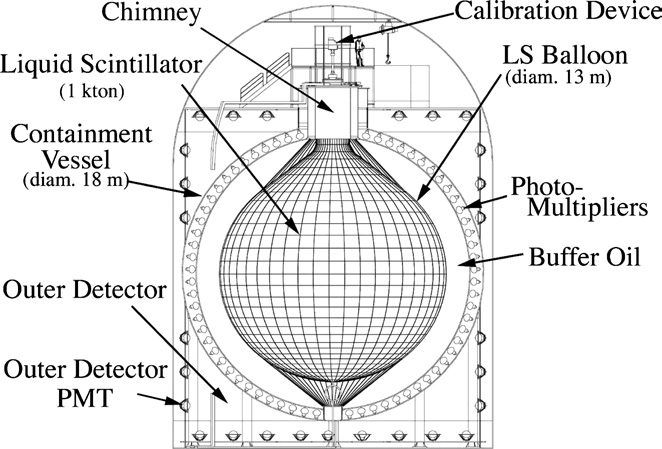

KamLAND — Kamioka Liquid Scintillator Antineutrino Detector — stands in that cavern in Japan in which the Kamiokande detector previously worked. It began operating in 2002 and delivered the finding that pinned down neutrino oscillation for good.
The set-up
At the centre hangs a balloon of wafer-thin plastic film holding 1,000 tonnes of scintillator, surrounded by a buffer liquid, a steel tank with 1,879 photomultipliers, and finally a water jacket. Above it lie 1,000 metres of rock.
Antineutrinos are detected via inverse beta decay — with the same delayed coincidence of two flashes of light that Cowan and Reines had devised in 1956.
That the facility could be built in an existing cavern saved years. Kamiokande had been superseded in 1996 by Super-Kamiokande and stood empty.
A whole country as the source
The distinctive feature of KamLAND is its source. Instead of a single reactor, the detector uses all of Japan's nuclear power stations — around 55 reactors at the time of construction, spread across the country, on average about 180 kilometres away.
This distance was the decisive point. Earlier reactor experiments had baselines of a few hundred metres up to a kilometre and found nothing. At 180 kilometres, by contrast, lies exactly the range in which the oscillation inferred from solar neutrinos ought to take effect.
That made it possible to settle a question that all solar measurements left open: does the same effect also show up with a source that one knows, whose strength one can calculate and which stands on Earth?
The disappearance
In 2002 KamLAND reported that antineutrinos were missing. About 40 per cent of the expected rate was not arriving.
That alone did not necessarily confirm oscillation — other explanations too would have produced a deficit. Decay of the neutrinos en route, an escape into additional spatial dimensions: both had been seriously considered.
The wave form
The real triumph followed two years later. With more data it was possible not only to count how many were missing, but also at which energy.
And there the characteristic shape showed itself: a trough in the spectrum, then a rise again, then a second trough. That is exactly what an oscillation looks like when plotted against energy — the probability swings back and forth.
A decay of the neutrinos would have given a smoothly falling spectrum, an escape into extra dimensions a different one. Only oscillation produces waves.
With that, the interpretation of the solar neutrino problem was confirmed independently of any assumption about the Sun, and the associated mass difference determined to within a few per cent.
The view into the Earth's interior
In 2005 KamLAND reported the first detection of geoneutrinos — antineutrinos from the radioactive decay of uranium and thorium in the Earth's mantle and crust.
The Japanese site is in itself unfavourable for this, because the many reactors produce a strong background. After almost all Japanese nuclear power stations were shut down from 2011 onwards, conditions improved involuntarily but considerably — a rare case in which an experiment benefited from an event outside science.
KamLAND-Zen
Since 2011 an additional, smaller balloon containing xenon-136, dissolved in the scintillator, has hung inside. With it the collaboration searches for neutrinoless double beta decay — that process which would show that the neutrino is its own antiparticle.
The design is remarkably economical: instead of erecting a new detector, the existing one is supplemented by a volume within the volume. The xenon can also be dissolved out and refilled, which allows modifications.
The decay was not found. The lower limits on the half-life are among the strictest worldwide.
Related
- Reactor neutrinos — the source
- Daya Bay — the other large reactor experiment
- Geoneutrinos — the view into the Earth's interior
- JUNO — the successor at twenty times the scale
Sources
- KamLAND Collaboration: First Results from KamLAND: Evidence for Reactor Antineutrino Disappearance, Physical Review Letters 90, 021802 (2003).
- KamLAND Collaboration: Experimental investigation of geologically produced antineutrinos with KamLAND, Nature 436, 499 (2005).