Cowan-Reines Experiment
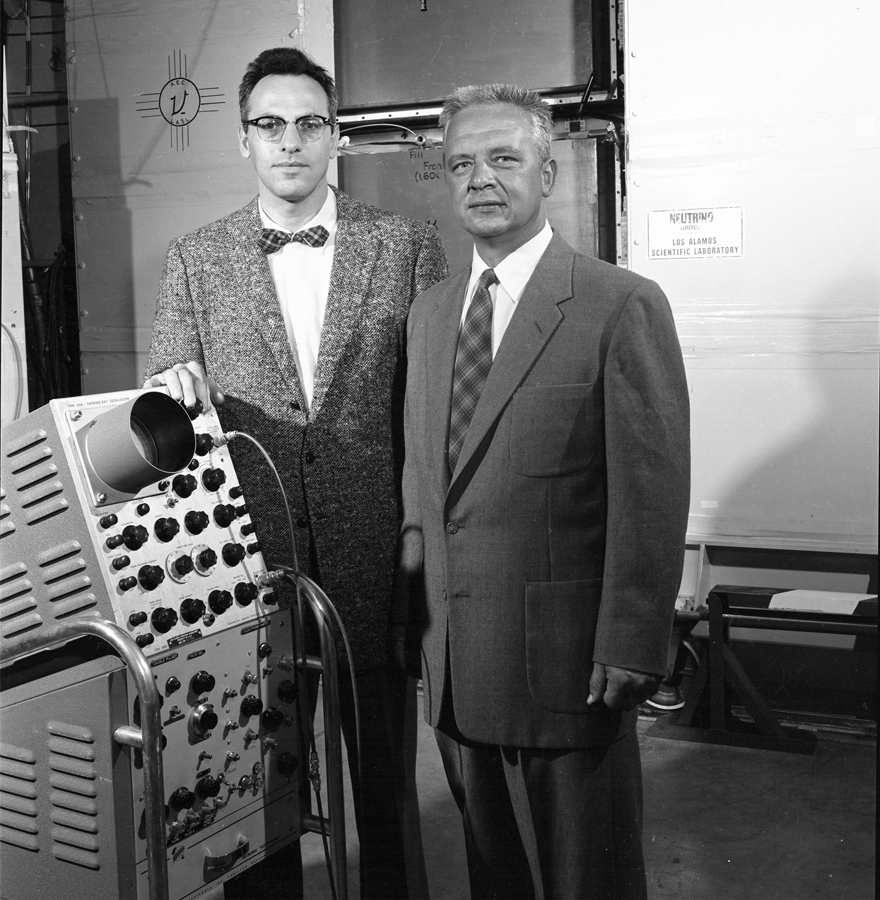

The Cowan-Reines experiment detected a neutrino for the first time in 1956 — 26 years after Wolfgang Pauli had proposed it and himself doubted that it would ever be found.
The physicists involved called their undertaking Project Poltergeist, after a ghost that makes itself noticed without being visible.
The first idea, discarded
Frederick Reines and Clyde Cowan worked at Los Alamos. Their first thought was as bold as it was obvious at the time: the detector was to be placed in a shaft next to a nuclear weapon explosion and to measure within a fraction of a second while the enormous flash of neutrinos passed by.
The plan was dropped — not because it was impracticable, but because a better one turned up. A nuclear reactor delivers antineutrinos continuously, and continuity permits something decisive: the reactor can be switched off and the same set-up measured without a signal.
This negative control was in the end the experiment's strongest argument.
The detection process
Inverse beta decay was used: an antineutrino strikes a proton and produces from it a neutron and a positron.
The clever part lay in the fact that two signals arise in succession.
The positron immediately meets an electron and annihilates. This produces two gamma quanta of 511 kiloelectronvolts each, flying in opposite directions — the first flash.
The neutron, by contrast, wanders about for a few microseconds until it is captured by a cadmium nucleus. This too releases the energy as gamma radiation — the second flash.
Two flashes at the right time interval, with the right energies, at the right place: this signature was hard to mistake. Today it is called delayed coincidence and it still carries every reactor measurement, from KamLAND to JUNO.
The set-up
After a first, inconclusive attempt at the Hanford reactor in 1953, the two moved in 1956 to the Savannah River reactor in South Carolina — with better shielding and a larger set-up, twelve metres underground.
Between three tanks of scintillator lay two containers holding around 200 litres of water each, in which cadmium chloride was dissolved. The water supplied the protons, the cadmium captured the neutrons. More than a hundred photomultipliers looked into each scintillator tank.
The yield was about three events per hour.
The controls
What made the experiment convincing were not the three events, but the checks alongside them.
Switching off. With the reactor idle the signal disappeared.
Reversing the order. If the expected order of the two flashes was swapped, nothing remained.
Removing the cadmium. Without the neutron catcher the second signal failed to appear.
Each of these tests could have overturned the result. None did.
Incidentally, the measured rate yielded the first experimental value for the cross section of the neutrino — and it agreed with the calculation by Hans Bethe and Rudolf Peierls, who twenty years earlier had concluded from it that detection was impossible.
The telegram
On 14 June 1956 Cowan and Reines sent a message to Zurich: neutrinos had been unambiguously detected. Pauli is said to have marked the evening with friends and a case of champagne — which, according to tradition, he had previously wagered on it never succeeding.
Legacy
Reines received the Nobel Prize in 1995. Cowan had died in 1974; the award is not given posthumously. Reines named him throughout his life as an equal partner, and in the specialist literature the experiment is still called after both.
Related
- Frederick Reines and Clyde Cowan
- Antineutrino — what arises at the reactor
- Wolfgang Pauli — the proposal of 1930
- Scintillator — the detection technique
Sources
- C. L. Cowan, F. Reines, F. B. Harrison, H. W. Kruse, A. D. McGuire: Detection of the Free Neutrino: A Confirmation, Science 124, 103 (1956).
- F. Reines: The neutrino: from poltergeist to particle, Nobel lecture 1995.