JUNO
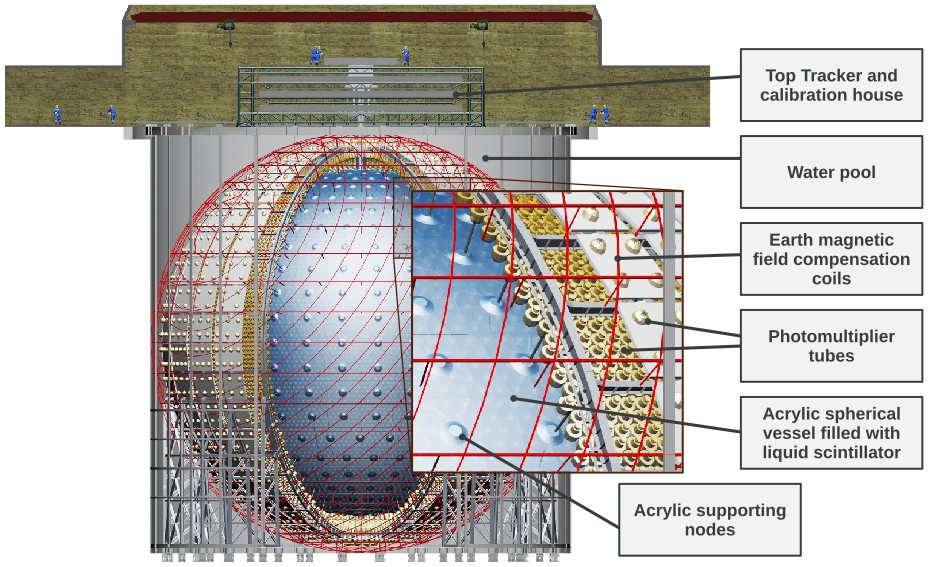

JUNO — the Jiangmen Underground Neutrino Observatory — is the largest liquid scintillator detector in the world. It lies 700 metres underground in the southern Chinese province of Guangdong and began taking measurements on 26 August 2025.
JUNO is thus the first project of the new generation of very large neutrino detectors actually to be taking data.
The question
That neutrinos possess mass has been established since 1998. What remains unknown to this day is their ordering.
From neutrino oscillation one knows only the differences of the squared masses, not the masses themselves. Two arrangements are compatible with all measurements: either two states are light and one considerably heavier — the normal ordering — or, conversely, two heavy and one light, the inverted ordering.
This question is not bookkeeping. On it hangs how promising the search for neutrinoless double beta decay is, how cosmology places the sum of the neutrino masses, and which models beyond the Standard Model come into consideration at all.
The trick: two power stations at the same distance
JUNO receives antineutrinos from two nuclear power stations, Taishan and Yangjiang. Both lie around 53 kilometres away — and deliberately almost exactly equally far.
The reason is a computational one. At this distance two oscillations with very different wavelengths overlap: a slow one and a fast one. The fast one produces a fine wave structure in the energy spectrum of the arriving antineutrinos, and exactly where these waves lie depends on the mass ordering.
Were the two power stations at different distances, their patterns would shift against one another and blur the fine structure. Hence the equal distance.
Why this is so hard
Making this wave structure visible demands an energy resolution that no detector of this size has yet achieved: around three per cent at one megaelectronvolt. By comparison: earlier scintillator detectors lay at six to eight per cent.
The resolution depends on how many photons are captured per event. JUNO therefore pushes three things to the limit simultaneously:
The volume. 20,000 tonnes of scintillator in an acrylic sphere 35.4 metres in diameter — the largest transparent vessel ever built.
The light yield. Around 17,600 large photomultipliers half a metre in diameter, supplemented by some 25,600 small ones. Together they cover almost eighty per cent of the sphere's surface.
The purity. The scintillator has to be as clean as that of Borexino — only in seventy times the volume. The purification plants for this were developed specially.
What else JUNO will measure
A detector of this size is never good for only one question.
Oscillation parameters. Three of the quantities that describe the PMNS matrix are to be determined by JUNO to better than one per cent — more precisely than all previous measurements together.
Geoneutrinos. With the large volume, the antineutrinos from the Earth's interior can be collected in appreciable numbers for the first time. That sharpens the statement about how much of the Earth's heat comes from radioactive decay.
Solar neutrinos. Here too the volume sets new standards.
Supernovae. If a star explodes in our galaxy, the collaboration expects several thousand events within seconds — more than a hundred times as many as with SN 1987A.
Proton decay. JUNO is sensitive to a decay channel that water detectors such as Super-Kamiokande see less well.
Assessment
The collaboration comprises several hundred researchers from around twenty countries, including institutes from Germany, Italy, France and Russia.
What is remarkable about JUNO is the precision of purpose in its design. The detector is not built large in general terms, but towards a particular number — the distance of 53 kilometres, at which the sought-after wave structure emerges most clearly. When a facility of this size hangs on a single distance, that shows how exactly the physics behind it had been worked through before the first sod was turned.
Related
- Reactor neutrinos — the source
- Neutrino mass — the open ordering
- Borexino — the benchmark for purity
- KamLAND — the precursor with the same technology
Sources
- JUNO Collaboration: JUNO Physics and Detector, Progress in Particle and Nuclear Physics 123, 103927 (2022).
- Institute of High Energy Physics, Chinese Academy of Sciences: JUNO Completed Liquid Filling and Begins Data Taking, 27 August 2025.