Borexino
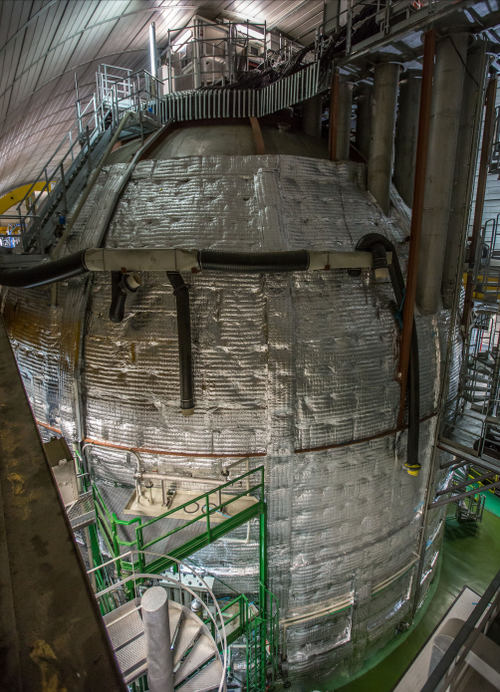

Borexino was a detector for solar neutrinos at the Gran Sasso underground laboratory in Italy. It ran from 2007 to 2021 and achieved something nobody had managed before: the measurement of individual solar neutrinos in real time and at low energy.
What was missing before
Radiochemical experiments such as Homestake or GALLEX count atoms. They deliver a sum over weeks and say nothing about when a neutrino arrived, what energy it had or which direction it came from.
Super-Kamiokande sees direction and time, but because of the low light yield of Cherenkov radiation it cannot go below about five megaelectronvolts.
Between the two there was a gap — and in that gap lie more than 99 per cent of all solar neutrinos.
The route via the scintillator
Borexino used a scintillator that delivers around ten thousand photons per megaelectronvolt instead of a few hundred. That lowers the detection threshold to a few hundred kiloelectronvolts.
The price: the directional information is lost, and background becomes the dominant problem. At such low energies the signal drowns in the natural radioactivity of the detector itself. Every gram of material contains traces of uranium, thorium and potassium — harmless in everyday life, devastating here.
The cleanest place in the world
Borexino therefore had to achieve a purity that had not existed before. The set-up was onion-like: 278 tonnes of scintillator in a wafer-thin nylon vessel, surrounded by a buffer liquid, a steel sphere with more than 2,000 photomultipliers and finally a water tank. Above it 1,400 metres of rock.
Only the innermost region of around one hundred tonnes was evaluated — the outer layers served solely to shield it.
A purity of about one uranium atom per 10¹⁸ atoms of the scintillator was reached. Developing the purification procedures took longer than building the facility.
The results
The effort paid off. Borexino measured almost all of the Sun's neutrino sources one after another:
| Year | Detection |
|---|---|
| 2007 | Beryllium-7 neutrinos, for the first time in real time |
| 2012 | pep neutrinos |
| 2014 | pp neutrinos — the Sun's main reaction |
| 2020 | Neutrinos from the CNO cycle |
The detection of the pp neutrinos in 2014 is the finest: it shows directly the very reaction from which the Sun draws by far the greatest part of its energy. One was watching the Sun burn — and indeed the process happening now, not the light that takes tens of thousands of years to reach the surface.
The CNO detection of 2020 closed a gap that Hans Bethe had opened in 1939. He had described two routes of nuclear fusion in stars; the second had for eight decades only been calculated, never seen. In the Sun it contributes only about one per cent — in heavier stars it dominates.
Along the way Borexino measured the transition region in which the MSW effect switches from vacuum to matter behaviour, and confirmed the predicted curve.
Geoneutrinos
With the same facility Borexino detected geoneutrinos — antineutrinos from radioactive decay in the Earth's interior. The Italian site is more favourable for this than the Japanese site of KamLAND, because fewer nuclear power stations stand nearby.
The 2020 measurement is to this day the most precise of its kind.
Legacy
Borexino was shut down in 2021. What remains is the technique: the purification procedures developed there stand today behind JUNO, which with 20,000 tonnes of scintillator has to achieve the same purity in seventy times the volume.
Related
- Solar neutrinos — what was measured
- Scintillator — the detection technique
- Geoneutrinos — the view into the Earth's interior
- JUNO — the successor in scale
Sources
- Borexino Collaboration: Neutrinos from the primary proton–proton fusion process in the Sun, Nature 512, 383 (2014).
- Borexino Collaboration: Experimental evidence of neutrinos produced in the CNO fusion cycle in the Sun, Nature 587, 577 (2020).