Hans Bethe
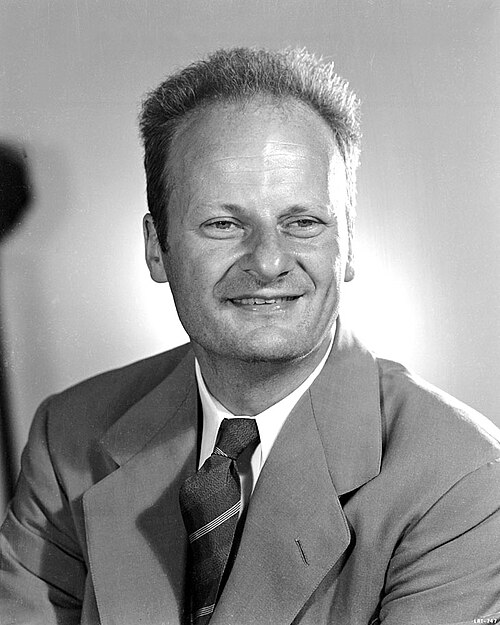

Hans Albrecht Bethe (2 July 1906 – 6 March 2005) was a German-American physicist. He explained how stars generate their energy and received the Nobel Prize in Physics for it in 1967.
For neutrino physics he is important in two respects: he described the reactions that give rise to solar neutrinos — and in 1934 he calculated how improbable it is ever to see a neutrino.
Career
Bethe was born in Strasbourg and took his doctorate in 1928 under Arnold Sommerfeld in Munich. In 1933, as the son of a Jewish mother, he lost his post in Tübingen and went by way of England in 1935 to Cornell University in Ithaca, New York, with which he remained associated for seventy years.
In the Second World War he headed the theory division at Los Alamos. After the war he campaigned for decades for arms control and was one of the most effective advocates of the test ban treaty of 1963.
"Not observable"
Shortly after Enrico Fermi had presented his theory of beta decay, Bethe and Rudolf Peierls calculated how strongly a neutrino would interact with matter. They arrived at a cross section of the order of 10⁻⁴⁴ square centimetres.
Their conclusion was sober: there was no practically feasible way of observing the neutrino. A particle with this cross section passes effortlessly through a block of lead several light years thick.
The calculation was right. The conclusion was not — it underestimated what can be achieved with very strong sources and very large detectors. Frederick Reines and Clyde Cowan demonstrated this in 1956, and their measured rate agreed with Bethe's figure.
Bethe later commented on this with visible pleasure. The anecdote is one of the most instructive in physics: a correct calculation becomes a false statement as soon as one infers from it the limits of what is feasible.
How stars burn
In 1938 and 1939 Bethe presented the work for which he received the Nobel Prize. The question was an old one: where does the Sun get its energy from? Chemical combustion would have sufficed for a few thousand years, contraction under its own gravity for a few million — geology demanded billions.
Bethe described two paths by which stars fuse hydrogen into helium:
The proton-proton chain. The path of lighter stars such as our Sun. Four protons become, step by step, a helium nucleus; positrons and neutrinos arise in the process. The first step requires a proton to convert into a neutron — a process of the weak interaction, and therefore so slow that the Sun burns for billions of years instead of exploding.
The CNO cycle. The path of heavier stars. Carbon, nitrogen and oxygen act as catalysts that are not themselves consumed.
The late confirmation
Both paths release neutrinos, and with different energies. That is precisely what later made them measurable.
Borexino detected the pp neutrinos in 2014. And in 2020 the same facility succeeded in detecting the CNO neutrinos — Bethe's second path, 81 years after his calculation and fifteen years after his death.
Few theoretical papers have had to wait so long for their direct confirmation.
Legacy
Bethe published into old age. Together with John Bahcall he wrote papers on the question of whether the missing solar neutrinos pointed to new particle physics. Both held the answer to be yes — and were proved right.
He died in 2005 at the age of 98, three years after Raymond Davis had received the Nobel Prize for measuring those neutrinos whose creation Bethe had calculated.
Related
- Solar neutrinos — the result of his reactions
- Cross section — his calculation of 1934
- Borexino — the late confirmation of the CNO cycle
- John Bahcall — his fellow campaigner on the solar model
Sources
- H. Bethe, R. Peierls: The Neutrino, Nature 133, 532 (1934).
- H. A. Bethe: Energy Production in Stars, Physical Review 55, 434 (1939).