Frederick Reines
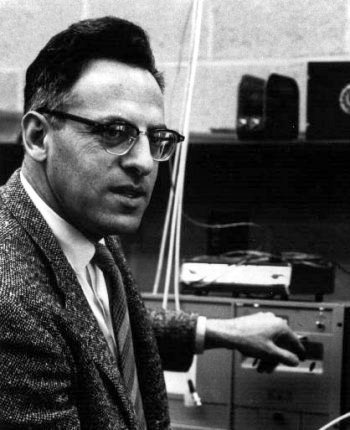

Frederick Reines (16 March 1918 – 26 August 1998) was an American physicist and the man who detected the neutrino for the first time. For this achievement he received the Nobel Prize in Physics in 1995 — 39 years after the experiment.
The road to detection
After the Second World War, Reines worked at Los Alamos. In 1951 he resolved to turn to a task that was considered insoluble: the experimental detection of that particle which Wolfgang Pauli had proposed in 1930 and which interacts with matter almost not at all.
Together with Clyde Cowan he developed a plan for it. The first idea was bold to the point of recklessness: they wanted to place the detector next to a nuclear weapon explosion, because there, for a moment, an enormous number of antineutrinos is set free.
The plan was discarded — not because it was impossible, but because a better one was found. A nuclear reactor delivers antineutrinos continuously, and continuity makes it possible to subtract background carefully.
The experiment at Savannah River
In 1956 Reines and Cowan set up their apparatus at the Savannah River reactor in South Carolina. They used inverse beta decay: an antineutrino strikes a proton and produces a neutron and a positron.
The trick lay in the detection. The positron annihilates immediately with an electron and yields two gamma quanta. The neutron wanders about for a few microseconds until it is captured by a cadmium nucleus, which likewise emits gamma radiation in the process. Two flashes at the right interval in time — this double signal was hard to mistake.
On 14 June 1956 the two sent a telegram to Wolfgang Pauli informing him that his particle had been found. Pauli is said to have marked the evening with friends and a case of champagne.
Further work
Reines remained faithful to the subject. In 1966 he went to the newly founded University of California, Irvine, and built up a research group for neutrino physics there.
His second great moment came in 1987. The IMB detector, which he had helped to build, in a salt mine in Ohio, registered eight neutrinos from the supernova SN 1987A on 23 February — at the same time as Kamiokande in Japan. Neutrino astronomy was thereby born.
The Nobel Prize of 1995
The Royal Swedish Academy of Sciences honoured Reines in 1995 "for the detection of the neutrino". He shared the prize with Martin Perl, the discoverer of the tau lepton.
Clyde Cowan had died in 1974 and could no longer be honoured — the Nobel Prize is not awarded posthumously. Reines pointed out at every opportunity that the work had been done jointly.
Assessment
Twenty-six years lay between Pauli's proposal and Reines' detection. Pauli himself had written that he had done something terrible: postulated a particle that could not be detected.
Reines' merit is that he did not accept this assessment. He took on a task that was considered hopeless and solved it with patience and a clever signal pattern. The whole of today's neutrino physics — from Super-Kamiokande to JUNO — stands on the ground he prepared.
Related
- Clyde Cowan — his partner
- Cowan-Reines experiment — the experiment in detail
- Wolfgang Pauli — the originator of the idea
- SN 1987A — his second great detection
Sources
- C. L. Cowan, F. Reines et al.: Detection of the Free Neutrino: A Confirmation, Science 124, 103 (1956).
- Nobel Foundation: Nobel Prize in Physics 1995, award motivation and biography.