T2K
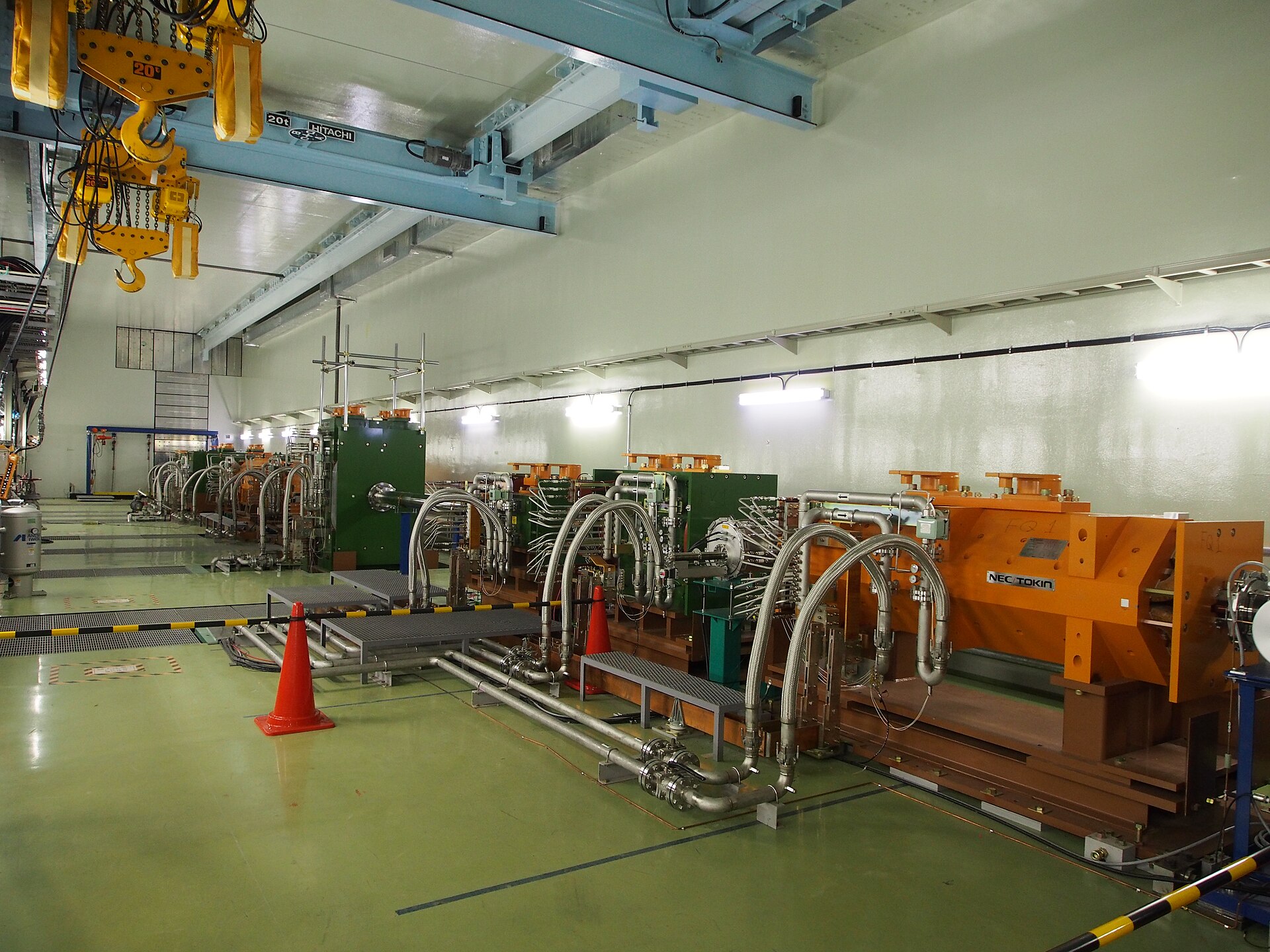

T2K — Tokai to Kamioka — is a Japanese experiment that sends neutrinos 295 kilometres straight across Honshū and observes along the way how they transform. It has been running since 2010 and in 2013 delivered the first proof that neutrinos do not merely disappear but appear again as another kind.
The set-up
At the J-PARC accelerator centre in Tokai on the east coast, protons strike a graphite target. Pions are produced, which are focused by magnetic horns and release muon neutrinos in a decay tunnel. Everything else is absorbed by shielding — the method Melvin Schwartz proposed in 1960.
280 metres behind the source stand two near detectors. INGRID sits exactly on the beam axis and monitors direction and strength. ND280 stands off to one side, in a magnet from a decommissioned CERN experiment, and measures the composition and spectrum of the beam before oscillation plays any part.
At the other end, 295 kilometres to the west, lies Super-Kamiokande and counts what arrives.
The trick of the oblique view
T2K works off-axis: the far detector does not stand on the beam axis but 2.5 degrees to the side of it.
That sounds like a disadvantage and is an advantage. On the axis the beam has a broad energy spectrum, because pions of different energy deliver neutrinos of different speed. A little to the side, the kinematics of the decay ensures that neutrinos from very different pion energies have almost the same energy. The beam becomes narrow and settles at around 600 megaelectronvolts.
That is not an arbitrary value. At 295 kilometres, neutrino oscillation has its maximum precisely there.
One thus loses intensity and gains sharpness. For a measurement that rests on the energy dependence, that is the better bargain — and the same manoeuvre is used today at NOvA and Hyper-Kamiokande.
The appearance of electron neutrinos
Until then oscillation had always been measured by disappearance: one sends muon neutrinos off and counts how many are missing. Where they go was not seen.
T2K searched the other way round for electron neutrinos in the beam, where there should really be none. In 2011 the collaboration reported six candidates — too few for a claim, enough for attention. By 2013 there were 28, with an expected background of just under five. The significance reached 7.3 standard deviations.
With that the transition νμ → νe was directly established, and the mixing angle θ₁₃ confirmed as different from zero — shortly after Daya Bay had determined it from reactor measurements.
That this angle is not zero was the precondition for everything that followed. Had it been zero, CP violation in the lepton sector could not be measured at all.
The indication of CP violation
T2K can reverse the polarity of its magnetic horns and produce antineutrinos instead of neutrinos. That makes it possible to ask: do the two transform equally often?
In 2020 the collaboration reported in Nature that the data fit best with a marked difference. A large part of the possible range of values for the parameter δ_CP was excluded, and the case of "no CP violation" lay outside the 95 per cent range.
That is an indication, not a proof. In particle physics a discovery counts only from five standard deviations. That requires Hyper-Kamiokande and DUNE — both of which are under construction partly for this reason.
Why this reaches beyond physics
The question behind CP violation is the question of our existence. At the Big Bang, matter and antimatter should have arisen in equal quantity. That matter was left over demands a difference in the behaviour of the two.
In the quark sector such a difference is known, but it is orders of magnitude too small. That leaves the neutrinos — and, via the seesaw mechanism and leptogenesis, a possible route from the lepton sector to the matter in the universe.
T2K has delivered the first indication that this route could be passable.
Related
- Super-Kamiokande — the target detector
- Hyper-Kamiokande — the successor
- Daya Bay — the parallel measurement of θ₁₃
- PMNS matrix — where δ_CP stands
Sources
- T2K Collaboration: Observation of Electron Neutrino Appearance in a Muon Neutrino Beam, Physical Review Letters 112, 061802 (2014).
- T2K Collaboration: Constraint on the matter–antimatter symmetry-violating phase in neutrino oscillations, Nature 580, 339 (2020).