Bruno Pontecorvo
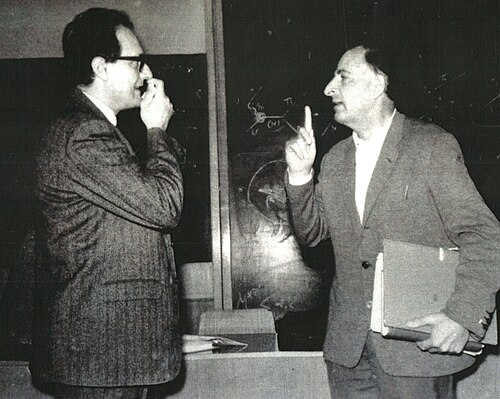

Bruno Pontecorvo (22 August 1913 – 24 September 1993) was an Italian-Soviet physicist. Two ideas that still carry neutrino physics today came from him: the method with which Raymond Davis detected solar neutrinos, and the notion of neutrino oscillation.
His name stands for the P in the PMNS matrix.
With Fermi in Rome
Pontecorvo grew up in Tuscany and came to Rome at eighteen, where he was taken into the working group around Enrico Fermi — the so-called Via Panisperna boys. He was the youngest among them; the others called him il cucciolo, the puppy.
In 1934 he took part in the discovery for which Fermi received the Nobel Prize: that slow neutrons trigger nuclear reactions far more effectively than fast ones.
When Italy enacted racial laws in 1938, Pontecorvo, being Jewish, left the country. By way of Paris, an escape route by bicycle ahead of the German Wehrmacht, the United States and Canada he reached Great Britain.
The chlorine-argon proposal
In 1946 Pontecorvo published a line of reasoning as to how the neutrino, at that time still undetected, might be found: by way of a nuclear reaction in which a chlorine-37 nucleus turns into argon-37.
The appeal of the proposal lay in the chemistry. Argon is a noble gas — it forms no compounds and can therefore be driven out of a large quantity of liquid, even if there are only a few atoms.
It was precisely this method that Davis put into practice twenty years later in the Homestake experiment.
The move to the Soviet Union
In 1950 Pontecorvo vanished with his family during a holiday in Italy and reappeared five years later in the Soviet Union. From then on he worked at the Joint Institute for Nuclear Research in Dubna.
The circumstances have not been fully clarified to this day. Pontecorvo was a convinced communist; at the same time he was under surveillance following the arrest of Klaus Fuchs. Whether he fled because he feared being exposed, or went out of conviction, is disputed.
The move had consequences for his scientific impact. His works now appeared in Russian and were noticed in the West with a delay — which explains why some of his ideas were attributed there only later.
The oscillation
In 1957 and 1958 Pontecorvo put forward in Dubna the idea that made him immortal.
With neutral kaons it was known that two states can turn into one another. Pontecorvo asked whether something similar might also be possible with neutrinos — that is, whether a neutrino might turn along the way into an antineutrino or into another kind.
At that time only one kind of neutrino was known, and the idea seemed idle. Only in 1962 did Maki, Nakagawa and Sakata in Japan formulate the mixing of three kinds in the form that is customary today.
In 1968, when Davis's first results showed the deficit, Pontecorvo was among the few who immediately pointed to oscillation as the explanation. Another thirty years were to pass before confirmation by Takaaki Kajita.
Further contributions
The idea that there might be more than one kind of neutrino also goes back to Pontecorvo. In 1959 he proposed testing this with an accelerator — which is exactly what Schwartz, Lederman and Steinberger did three years later, and they received the Nobel Prize for it.
Pontecorvo himself never received it.
Legacy
He died in Dubna in 1993. His ashes were divided: one half lies in the Protestant cemetery in Rome, the other in Dubna — a final expression of that division which had determined his life.
Of the three great ideas of early neutrino physics — the particle itself, the theory that went with it and oscillation — the third came from him.
Related
- Neutrino oscillation — his idea of 1957
- PMNS matrix — the P in the name
- Homestake experiment — his detection method
- Enrico Fermi — his teacher
Sources
- B. Pontecorvo: Inverse beta process, Chalk River Report PD-205 (1946).
- B. Pontecorvo: Mesonium and antimesonium, Soviet Physics JETP 6, 429 (1957).