Masatoshi Koshiba
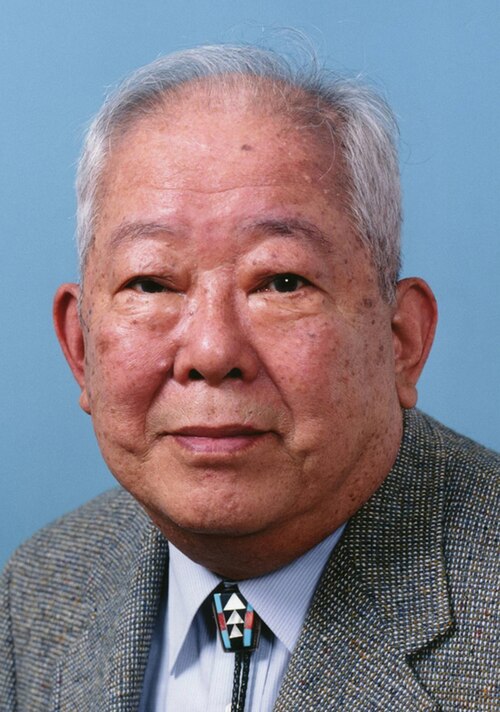

Masatoshi Koshiba (小柴 昌俊, 19 September 1926 – 12 November 2020) was a Japanese physicist. He built the detector with which neutrinos from a supernova were detected for the first time in 1987, and thereby founded neutrino astronomy. In 2002 he received the Nobel Prize in Physics.
An improbable career
Koshiba contracted polio as a child and was left with a paralysed right hand. The path into the military, which many of his schoolmates took, was thereby closed to him.
He studied physics at the University of Tokyo and graduated there with remarkably poor marks — a fact he later liked to mention himself in lectures, complete with the certificate. Afterwards he went to the United States and took his doctorate in 1955 at the University of Rochester, where he worked on cosmic radiation.
In 1970 he became a professor at the University of Tokyo.
Kamiokande: built for the wrong question
In the early 1980s Koshiba pushed through a detector that had a quite different task from the one for which it became famous. Grand unified theories predicted that protons decay — extremely rarely, but measurably, if only one has enough of them together.
The name says it: Kamioka Nucleon Decay Experiment, Kamiokande for short. Three thousand tonnes of water in a zinc mine, 1,000 metres underground, surrounded by about a thousand photomultipliers.
Proton decay was never observed. It has not been found to this day.
Koshiba recognised, however, that the same facility could do something else if it were made more sensitive: measure solar neutrinos — and do so in real time and with directional information, which the Homestake experiment with its chlorine tank could not manage. The conversion into Kamiokande-II was completed at the end of 1986.
23 February 1987
A few weeks later a star exploded in the Large Magellanic Cloud, some 168,000 light years away. It was the first supernova visible to the naked eye since 1604.
On that day Kamiokande-II registered eleven neutrinos within 13 seconds. At the same time the IMB detector in a salt mine in Ohio saw eight more, and the Baksan Observatory in the Caucasus five. Together 24 events — and with them a new field of study.
The coincidence in time can hardly be overestimated. Had the conversion been finished six months later, no one would have seen anything. Koshiba himself later said that in those days he had grasped how much in science depends on luck — and how little one can do about it other than be ready.
What the events showed is also remarkable: the neutrinos arrived hours before the light. They leave the collapsing stellar core immediately, whereas the light first has to work its way through the outer shells. What sounds like a contradiction is a confirmation of the core-collapse model.
Solar neutrinos with direction
Kamiokande also settled a question that had been open for decades. Davis's tank in South Dakota counted atoms and delivered a sum over weeks. Whether the counted neutrinos really came from the Sun could not be read off from that.
Kamiokande saw the direction. And the neutrinos came from the direction of the Sun. With that the solar neutrino problem was definitively a problem of physics and no longer one of measurement technique.
Nobel Prize and after-effect
Koshiba shared the 2002 Nobel Prize with Raymond Davis — the two men whose detectors approached the same riddle from two sides — and with Riccardo Giacconi for X-ray astronomy.
His most important legacy, however, is not a measurement but a school. From his research group came Takaaki Kajita, who himself received the Nobel Prize in 2015. And Kamiokande became Super-Kamiokande, whose successor Hyper-Kamiokande is currently being built.
Koshiba died in 2020 at the age of 94.
Related
- SN 1987A — the supernova
- Neutrino astronomy — the field he founded
- Takaaki Kajita — his student
- Raymond Davis — his co-laureate
Sources
- K. Hirata et al. (Kamiokande-II): Observation of a neutrino burst from the supernova SN1987A, Physical Review Letters 58, 1490 (1987).
- Nobel Foundation: Nobel Prize in Physics 2002, citation and Nobel lecture Masatoshi Koshiba.