Helicity
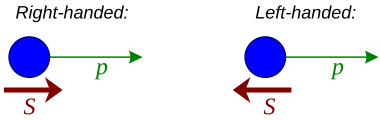

Helicity describes how a particle's intrinsic angular momentum stands in relation to its direction of flight. For the neutrino it is remarkable: all observed neutrinos are left-handed, all antineutrinos right-handed.
No other particle shows such one-sidedness.
The picture of the corkscrew
Every particle with spin has an axis of rotation. If the spin points along the direction of flight, the particle is called right-handed; if it points against it, left-handed.
A corkscrew helps: a right-hand thread moves forward when turned clockwise, a left-hand thread backwards. Sense of rotation and direction of motion are coupled.
For electrons both possibilities occur about equally often. For the neutrino, apparently not.
Goldhaber's masterpiece
In 1958 Maurice Goldhaber, Lee Grodzins and Andrew Sunyar determined the helicity of the neutrino at Brookhaven National Laboratory. Their set-up counts to this day as one of the most elegant experiments in nuclear physics.
The neutrino itself cannot be measured. So they measured something else.
An excited europium-152 nucleus captures an electron from the innermost shell. In doing so only two things are produced: a neutrino and an excited samarium nucleus, which shortly afterwards gives off a gamma quantum. Because nothing else arises, angular momentum and momentum are strictly shared between the two.
If the gamma quantum flies in one direction, the neutrino must have gone in the opposite one. And the angular momentum balance couples the polarisation of the light to the helicity of the neutrino.
The second trick was the selection. Only gamma quanta that fly exactly opposite to the neutrino carry the full energy and can be resonantly scattered in samarium. This made it possible to filter out of all the emitted quanta precisely the sort being sought.
The polarisation was analysed in magnetised iron, where light is absorbed to a different degree depending on its sense of rotation.
Result: neutrinos are left-handed. The whole experiment managed with an apparatus a few metres across.
The connection with parity
This one-sidedness is a property of nature, not an accident of the set-up.
Two years earlier Chien-Shiung Wu had shown that the weak interaction distinguishes between left and right. It couples only to left-handed particles and right-handed antiparticles.
Since neutrinos make their appearance solely through this force, right-handed neutrinos simply do not occur in the observable world. Even if they existed, they would be invisible to any detector.
Why mass complicates everything
As long as neutrinos were held to be massless, the picture was closed. A massless particle moves at the speed of light; its handedness is the same for every observer, because nobody can overtake it.
For a particle with mass it is different. It is slower than light, and a sufficiently fast observer could overtake it. Seen from in front the direction of flight reverses, but the spin does not — left-handed becomes right-handed.
Neutrino oscillation establishes the mass. So there must be right-handed states. They evidently just barely interact.
The two ways out
Dirac. The right-handed neutrinos are particles in their own right that take part in no known force. If they are very heavy, the route leads to the seesaw mechanism.
Majorana. Neutrino and antineutrino are the same particle in two forms of appearance — so Ettore Majorana proposed in 1937.
The decision could be made only by neutrinoless double beta decay. It has not been found.
Related
- Chien-Shiung Wu — parity violation
- Weak interaction
- Beta decay — the electron capture in the experiment
- Ettore Majorana
Sources
- M. Goldhaber, L. Grodzins, A. W. Sunyar: Helicity of Neutrinos, Physical Review 109, 1015 (1958).