Energy Harvesting

Energy harvesting means obtaining small amounts of electricity from the immediate surroundings. Not from a power station, not from a battery, but from what is there anyway: light, heat, motion, radio waves.
Neutrinovoltaic technology belongs to this family. Anyone wanting to place it should know the other members.
The idea behind it
Classical power engineering is about quantity: a power station should deliver as much as possible. Energy harvesting is about something else — about independence.
A sensor that needs one milliwatt is not an energy problem. It is a maintenance problem. A battery lasts a few years, then somebody has to drive out to it. With ten sensors that is a task; with ten thousand it is a business model that does not work.
This is why the field measures not in kilowatts but in microwatts per square centimetre — and the decisive question is not "how much?" but "how long without intervention?".
The established sources
| Source | Principle | Order of magnitude |
|---|---|---|
| Light outdoors | photovoltaics | a few milliwatts per cm² |
| Light indoors | photovoltaics | 10 to 100 microwatts per cm² |
| Temperature gradient | thermoelectrics | about 100 microwatts per cm² at 5 K difference |
| Vibration | piezoelectrics | a few hundred microwatts per cm³ |
| Radio waves | rectenna | fractions of a microwatt per cm² |
| Beta decay | betavoltaics | microwatts, but for decades |
The spread across five orders of magnitude is the actual finding. There is no such thing as the ambient energy, but rather channels of very different yield — and each has its condition. Photovoltaics needs light, thermoelectrics a gradient, piezoelectrics motion.
Why storage belongs to it
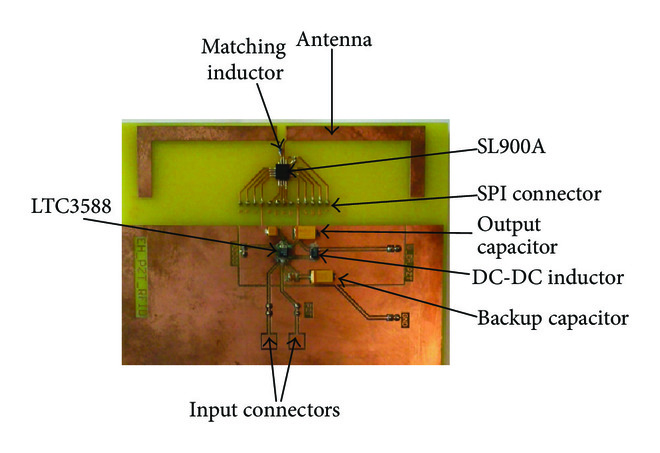
Hardly any source delivers evenly. An energy-harvesting system therefore almost always consists of three parts: the converter, a conditioning circuit and a store.
The store is often a supercapacitor rather than a battery — it tolerates hundreds of thousands of charge cycles and barely ages.
To this comes a trick from electronics: duty cycling. A sensor does not measure continuously but sleeps and wakes every few minutes for milliseconds. A source far below what the device draws in operation is thereby sufficient on average.
Where it runs today
Energy harvesting is not a technology of the future but everyday practice. Wireless light switches need no battery and draw their energy from the press of a finger. Tyre pressure sensors use vibration. RFID tags live off the energy of the reader. Wristwatches have been charging themselves from the motion of the wrist for decades.
In all these cases the same pattern holds: the energy is small, but the alternative — sending somebody out — is more expensive.
What neutrinovoltaic technology claims
The approach of the Neutrino® Energy Group differs in two respects from everything named above.
In the source. Instead of a single channel the group names a bundle: neutrinos, cosmic muons, electromagnetic fluctuations and thermal motion. The appeal lies in the fact that these fluxes are present everywhere — in the dark, underground, inside a device.
In the order of magnitude. For the Neutrino Power Cube the group names 5 to 6 kilowatts and marks these values as design targets in development. That lies many orders of magnitude above anything customary in energy harvesting so far.
Precisely therein lies the challenge of the undertaking — and precisely for that reason placing it in this field is useful: it makes visible the standard against which success will later have to be measured.
Related
- Ratchet effect — rectification of thermal motion
- Neutrino Power Cube — the claimed order of magnitude
- Graphene — the converter material
Sources
- Neutrino® Energy Group: Energy Harvesting, neutrino-energy.com/technology/energy-harvesting/.