Thermoelectrics
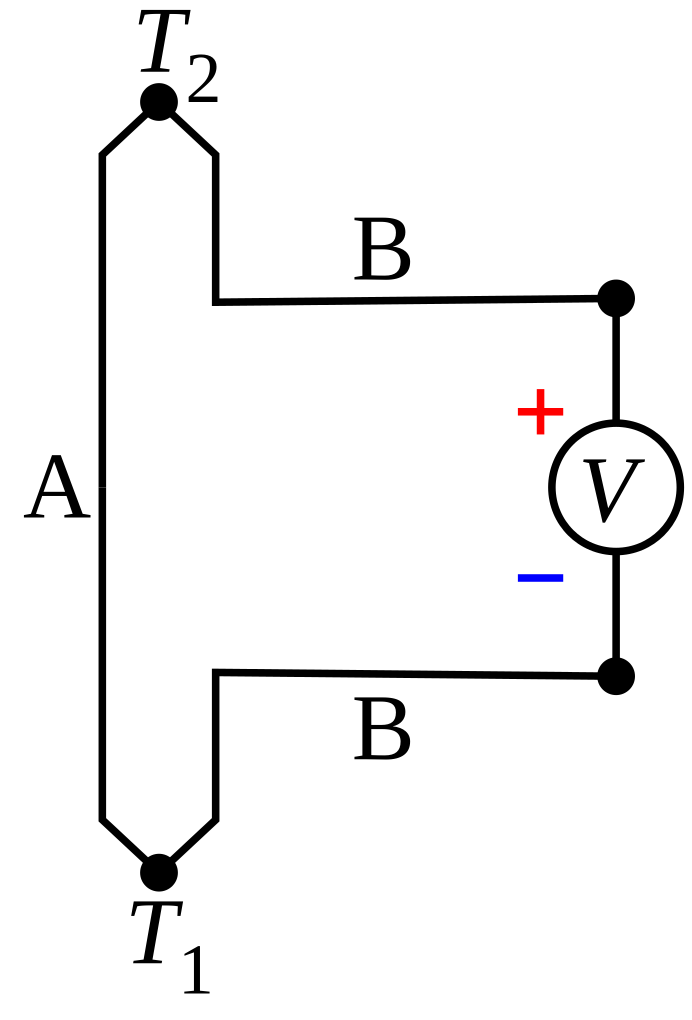

Thermoelectrics converts a temperature difference directly into electrical voltage — without turbine, without piston, without a single moving part. It is thus the oldest and best-documented technique in that family of methods to which neutrinovoltaic technology also belongs: electricity from what is there anyway.
The Seebeck effect
Thomas Johann Seebeck discovered the basic process in 1821. If two different conductors are joined into a circuit and the two junctions are held at different temperatures, a current flows.
The reason is vivid: on the warm side the charge carriers have more kinetic energy and migrate to the cold side. There they accumulate, and a voltage arises. How large it turns out is described by the material's Seebeck coefficient, measured in microvolts per kelvin.
The reverse works as well: send a current through, and one side becomes cold. That is the Peltier effect, used by every small cool box.
The figure of merit ZT
How well a material serves for thermoelectrics is summed up by a single dimensionless number:
ZT = S²σT / κ
Here S stands for the Seebeck coefficient, σ for the electrical conductivity, κ for the thermal conductivity and T for the temperature.
This formula shows the field's core problem. One needs a material that conducts electricity well but heat badly — and in most substances the two conductivities go hand in hand, because the same electrons are responsible for both. The field has been looking for decades for materials that break this coupling.
Bismuth telluride, the classic for room temperature, reaches a ZT of about 1. That corresponds to efficiencies of about 5 to 8 percent. Laboratory values above 2 have been achieved, but rarely stable and rarely cheap.
Where it is in use
Despite the modest efficiency, thermoelectrics is unbeatable wherever reliability counts above everything:
Spaceflight. The radioisotope batteries of the Voyager probes have been working since 1977 — plutonium-238 delivers heat, thermocouples make electricity from it. The Mars rovers Curiosity and Perseverance use the same design and obtain about 110 watts of electricity from roughly 2,000 watts of heat.
Waste heat. Industrial furnaces, engines and exhaust systems give off heat that would otherwise be lost.
Small sensors. Where a hand's breadth of temperature difference suffices to feed a radio module, no battery is needed any more.
Distinction from neutrinovoltaic technology
Thermoelectrics necessarily requires a gradient. Without a warm and a cold side no current flows — a component at the same temperature all round delivers nothing, no matter how hot it is. That is not a technical shortcoming but the second law of thermodynamics.
Neutrinovoltaic technology names thermal fluctuations as one of several input channels, but does not rely on a macroscopic gradient; it relies on processes within the lattice itself. The connection to research lies here with the work of Paul Thibado on the rectification of thermal motion in freestanding graphene — the ratchet effect.
Thermoelectrics is thereby the best evidence that the basic idea holds: direct conversion without moving parts works, has been known for two centuries and has been flying through the solar system for half a century. The question is not whether energy can be obtained this way, but from which source and in what quantity.
Related
- Energy harvesting — the field as a whole
- Ratchet effect — rectification of thermal motion
- Photovoltaics in comparison — the other yardstick
Sources
- T. J. Seebeck: Magnetische Polarisation der Metalle und Erze durch Temperaturdifferenz, Abhandlungen der Königlichen Akademie der Wissenschaften zu Berlin, 1822/23.
- NASA: Radioisotope Power Systems — data sheets on MMRTG and the Voyager RTG.