Metamaterial
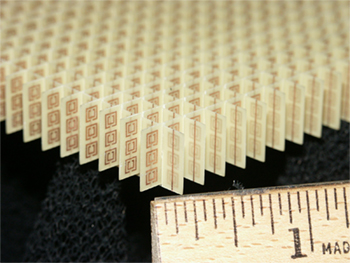

A metamaterial is a material whose properties follow not from its constituents but from their arrangement. The Greek prefix meta means "beyond" — beyond, that is, what nature holds ready in the way of materials.
The idea is simple and far-reaching at once. If small structures are arranged in a pattern considerably finer than the wavelength used to illuminate them, the wave does not "see" the individual parts but a material with averaged properties. These averaged properties can be set through the geometry — and they can take values no natural substance possesses.
The negative refractive index
The best-known example is a negative refractive index. The Soviet physicist Victor Veselago considered theoretically in 1968 what would happen if a material had negative permittivity and negative permeability at the same time: light would be refracted in the wrong direction on entering.
No such material was known at the time. Thirty years later John Pendry described how one might be built, and in 2000 a group around David R. Smith at the University of California, San Diego, demonstrated the effect experimentally in the microwave range — with a lattice of thin wires and split-ring resonators.
Metamaterials have been a research field of their own ever since. In 2006 a first cloaking device for microwaves succeeded, letting a wave flow around an object at a particular frequency.
What they are used for
Metamaterials have long ceased to be a laboratory curiosity:
- Antennas — compact designs with directivity that would classically need more space
- Acoustics — sound insulation that blocks particular frequencies selectively
- Optics — lenses that resolve more finely than the classical diffraction limit allows
- Mechanics — materials that thicken when pulled instead of narrowing
- Heat — arrangements that steer heat flows
Common to all: the function lies in the structure, not in the substance.
Relation to neutrinovoltaic technology
For the Neutrino® Energy Group this idea is central. Neutrinovoltaic technology rests not on a particular element but on a particular layering: alternating layers of graphene and silicon at the nanometre scale, ten to twenty of them according to patent WO2016142056A1, twelve in particular.
Here too the metamaterial principle holds: neither carbon nor silicon does anything remarkable on its own. The expectation is directed at the lattice they form together — and at the fact that this lattice does not occur in nature in this form.
Metamaterials are also foreseen for the bodywork of the Pi Car. The group describes them there as a means of translating ambient fluxes into mechanical micro-oscillations which, together with the doped nanolayers, produce resonance.
Why the structure makes so much difference
An image helps. A brick house and a brick path consist of the same material; one keeps warmth in, the other carries weight. The difference lies solely in the arrangement.
With metamaterials it is the same, only a million times smaller — and the arrangement decides not about warmth or load-bearing but about how a wave or a particle interacts with the substance. That this interaction can be designed rather than merely accepted is the real gain.
Related
- Graphene — one half of the layer stack
- Doped graphene — deliberately altered lattice structure
- Pi Car — metamaterials in the bodywork
- Neutrinovoltaic technology — the method behind it
Sources
- V. G. Veselago: The electrodynamics of substances with simultaneously negative values of ε and μ, Soviet Physics Uspekhi 10, 509 (1968).
- D. R. Smith et al.: Composite Medium with Simultaneously Negative Permeability and Permittivity, Physical Review Letters 84, 4184 (2000).
- Neutrino® Energy Group: The Pi Car, thepi.energy.